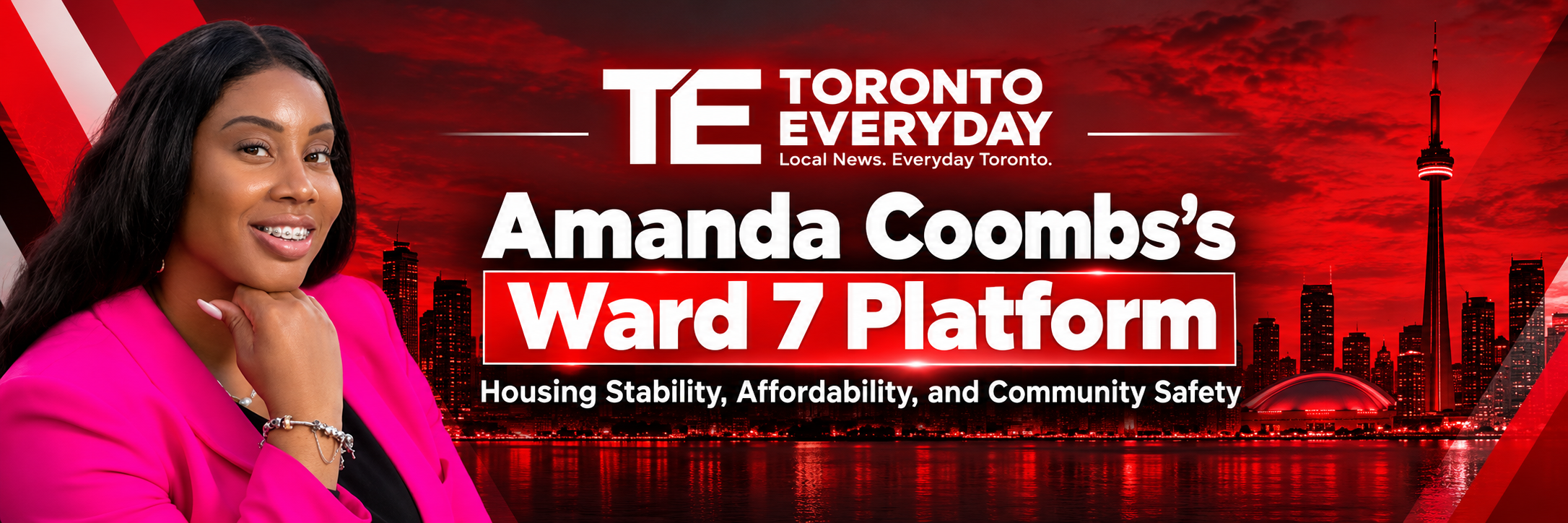
Amanda Coombs is running for Toronto City Council in Ward 7, Humber River–Black Creek.
Her current campaign platform is organized around four main priorities:
Cost of Living
Housing Stability
Support for Vulnerable Residents
Community Safety
Her campaign presents those priorities as interconnected issues affecting whether residents can afford to remain in the community, access support and feel secure in their neighbourhoods.
The important questions for Ward 7 residents are not only what those priorities are, but also what specific municipal actions would be used to pursue them, how they would be funded and how residents could measure progress.
Housing Stability
Housing stability is one of the central themes of Coombs’s campaign.
Her platform says she supports:
Eviction prevention
Tenant supports
Housing advocacy
Reducing homelessness and displacement
Helping residents remain securely housed
The campaign connects housing stability with broader neighbourhood stability, arguing that keeping existing residents housed can help maintain stronger communities.
These are broad policy objectives.
For voters, the next level of detail would be understanding exactly what a Ward 7 councillor could pursue through City Council.
That could involve questions such as:
Would she propose changes to RentSafeTO?
Would she seek additional tenant-support funding?
Would she advocate for more affordable housing through City-owned land or development agreements?
Would she seek additional resources for eviction-prevention programs?
Would she propose changes to how apartment complaints are tracked?
Those details are not yet set out in the campaign platform reviewed for this article.
Cost of Living
Coombs’s platform also identifies the cost of living as a major priority.
Her campaign says its affordability approach includes:
Housing affordability
Food access
Financial stability
Reducing financial pressure on families
Preventing displacement
The platform says the goal is to help long-term residents remain in the community rather than being pushed out by rising costs.
The City has some tools that can affect household costs, including transit discounts, childcare subsidies, recreation supports, affordable-housing programs and access to social services.
However, Toronto City Council does not independently control every major cost affecting residents.
Private-sector wages, interest rates, federal taxation, provincial social-assistance policy and many broader market prices fall partly or entirely outside municipal authority.
That makes the implementation question especially important:
Which affordability measures would Coombs pursue specifically through City Council?
Her current platform describes the objective but does not yet provide a detailed costing or municipal implementation schedule.
Support for Vulnerable Residents
The third pillar focuses on residents who may face additional barriers.
The campaign specifically identifies:
Seniors
Youth
Newcomers
Single-income households
People experiencing hardship
Coombs says she wants accessible and inclusive programs that increase independence and strengthen support systems for these groups.
This part of the platform connects closely with her documented community-service background.
A City of Toronto public-appointments profile identifies Coombs as a Toronto Community Housing tenant representative in the Jane and Finch community and describes her experience working in shelters, group homes and mental-health facilities providing crisis intervention and mediation. The same City profile identifies her as the founder of Back2Basikz.
That background establishes experience in community and support work.
It does not, by itself, show how a City Council policy would be designed or funded.
Those are separate questions voters can ask during the campaign.
Community Safety
Coombs’s campaign describes community safety primarily through a prevention-focused approach.
The platform refers to:
Safe public spaces
Community programs
Responsive services
Reducing harm and violence
Building community trust
Her campaign also argues that public safety should involve investment in areas such as youth, families, mental-health support, recreation and employment opportunities rather than being discussed only through policing.
That creates several practical questions for Ward 7 residents.
Which prevention programs would receive additional support?
Would new City funding be required?
Would existing programs be expanded?
What outcomes would be measured?
How would the City determine whether violence-prevention or youth-support programs were working?
A prevention-focused safety strategy becomes easier to assess when those details are available.
Coombs Has a Documented History of Youth Programming
Coombs’s community work predates the current campaign.
York University reported in 2024 that Back 2 Basickz Youth Support Services, founded by Coombs, began in the Jane and Finch neighbourhood in 2013 and later expanded with a centre in Scarborough.
York described its programming as including:
Academic support
Mentorship
Employment opportunities
Counselling
Mental-health support
Life-skills development
Support for youth involved with the justice system.
York University’s Community Engagement Centre has also documented Back2Basics programming serving youth in the Jane-Finch area, including mentorship, life skills, academic assistance and wellness programming.
This provides independent evidence of community-program experience associated with Coombs.
Employment and Entrepreneurship Experience
Coombs has also participated in employment and entrepreneurship initiatives.
In 2018, York University reported that Back 2 Basickz worked with LaunchYU on the Passion into Profit initiative, which planned to train up to 24 prospective entrepreneurs from the Jane and Finch community.
The initiative included workshops, mentorship and small business-development support.
More recently, York University reported that Back 2 Basickz programming included employment support and job-placement assistance for Black youth and young adults.
That experience is relevant to understanding Coombs’s background.
However, running or partnering in a community program is different from managing a municipal budget or passing City policy.
A councillor would need to work through Council decisions, City departments, budgets and partnerships to turn similar objectives into municipal programs.
Previous Ward 7 Election Experience
Coombs has run for Ward 7 councillor before.
Official City of Toronto results from the 2022 municipal election show:
Anthony Perruzza received 8,707 votes.
Christopher Mammoliti received 3,215 votes.
Amanda Coombs received 2,282 votes.
Perruzza was elected.
Those are historical 2022 results and should not be interpreted as evidence about how residents will vote in the 2026 election.
What Does Her Current Platform Promise?
The current campaign platform is best understood as a statement of priorities rather than a detailed municipal implementation plan.
Its four main pillars are clear:
Cost of Living
Improve affordability, food access and household financial stability.
Housing Stability
Support tenants, prevent displacement and help residents remain housed.
Support for Vulnerable Residents
Expand support for seniors, youth, newcomers, single-income households and residents facing hardship.
Community Safety
Use prevention, community programming, safe public spaces and responsive services to reduce harm and strengthen neighbourhood safety.
The campaign also says Coombs would work with City Council, provincial and federal representatives and community organizations to pursue local priorities.
What Is Still Missing From the Platform?
As of the platform reviewed in September 2026, several implementation details remain unclear.
The campaign page does not yet provide a detailed municipal budget for the proposals.
It does not identify specific Council motions Coombs would introduce.
It does not provide detailed first-year timelines for each priority.
It does not set numerical targets for housing, safety, affordability or service improvements.
And it does not yet explain how progress on each commitment would be publicly measured.
That does not mean those details will not be provided later.
The campaign itself describes the platform as a “living document,” indicating that additional material may be added.
Five Follow-Up Questions for Amanda Coombs
Ward 7 residents could ask:
1. What is the first specific City Council action you would take on housing stability?
Would it involve RentSafeTO, eviction prevention, affordable housing, tenant supports or another program?
2. Which City-controlled household cost would you address first?
Transit, recreation, childcare, housing services or another area?
3. What additional support would you seek for youth and vulnerable residents, and how much would it cost?
Would funding come from an existing City program or require new budget spending?
4. Which specific community-safety initiative would you prioritize in Ward 7?
How would its impact be measured?
5. How would residents publicly track your commitments after the election?
Would there be a published tracker, regular community reports or another accountability system?
These questions would turn broad platform priorities into commitments that residents could follow over time.
Campaign Website Details Should Be Read Carefully
There are also some apparent copy inconsistencies on Coombs’s current campaign website.
Although the campaign is clearly presented as a campaign for Ward 7 Humber River–Black Creek, the platform page currently contains a reference asking residents what they want to see in “Parkdale–High Park.”
Another campaign page includes the heading “Amanda’s Priorities for Scarborough” while discussing Jane and Finch and Ward 7 priorities.
These appear on the campaign’s own website and should be clarified or corrected by the campaign.
They do not, on their own, establish anything about Coombs’s policy positions.
How Should Residents Assess the Platform?
There are two separate records residents can consider.
The first is Coombs’s documented community background, including tenant representation and youth, employment, mentorship and support programming.
The second is her 2026 campaign platform, which currently emphasizes housing stability, affordability, vulnerable residents and prevention-focused community safety.
The next stage is specificity.
Residents can watch for:
Specific Council proposals
Funding sources
First-year priorities
Implementation timelines
Measurable targets
Public accountability mechanisms
Those details would make it easier to compare what is promised during the campaign with what could later be tracked through City Council records.
Toronto Everyday will continue reviewing Ward 7 candidate platforms, public records and documented proposals as the campaign develops.
Source: Toronto Everyday News (https://www.facebook.com/torontoeverydayupdate)