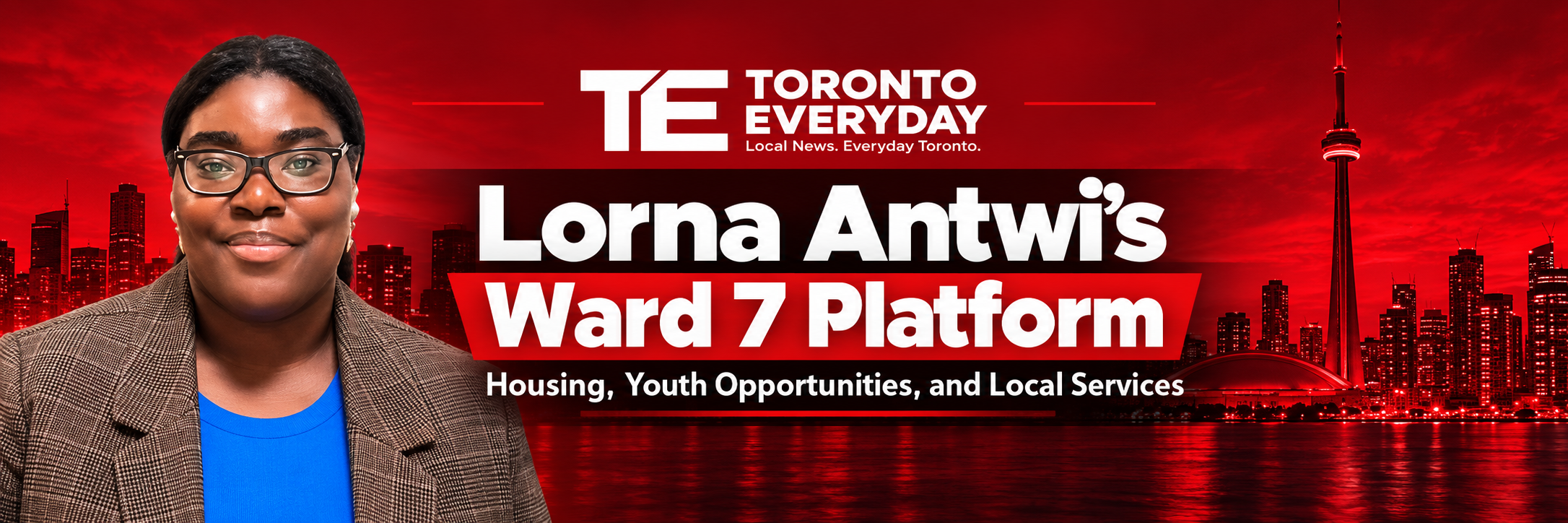
Lorna Antwi’s Ward 7 Platform: Housing, Youth Opportunities, and Local Services
Ward 7 residents have several choices in Toronto’s 2026 municipal election, and understanding what each candidate is actually proposing is more useful than relying on campaign slogans alone.
Lorna Antwi is a registered candidate for Toronto City Council in Ward 7, Humber River–Black Creek. Public candidate directories list her registration date as May 11, 2026.
Her campaign presents a platform focused on affordable housing and tenant protections, community safety and mental-health supports, youth employment and mentorship, streets and infrastructure, small businesses, food security, families with disabilities, affordability for seniors and safe community spaces.
The important question for residents is:
What does each proposal mean in practice, what could a city councillor actually influence, and what details still need to be explained?
Who Is Lorna Antwi?
Antwi’s campaign describes her as a lifelong Humber River–Black Creek resident who attended Brookview Middle School and later Seneca Polytechnic at York.
Her campaign also says she has worked with children, youth, families, seniors, newcomers and refugees through community advocacy and social services, and currently works as a counsellor with Toronto Shelter & Support Services. These biographical details are statements published by her campaign.
She says those experiences have exposed her to issues including housing instability, food insecurity, unemployment, mental-health challenges and barriers facing young people and families.
That professional and community-service background is a central part of how her campaign presents her candidacy.
But experience and policy are separate questions.
Residents can also examine what she proposes to do if elected.
Affordable Housing and Tenant Protections
Housing is one of the most prominent parts of Antwi’s platform.
Her campaign says she would advocate for:
Rent control
Stronger eviction prevention
Faster housing construction
Reducing waits for subsidized housing
and
Support for first-time homebuyers facing affordability barriers.
Her community-priorities page also highlights rising rent, eviction risk, overcrowding, homelessness and barriers facing first-time buyers.
These are substantial issues, but they involve different levels of government and different policy tools.
Rent Control Is Not Controlled by One Toronto Councillor
This distinction is important when reading the platform.
Ontario’s Residential Tenancies Act establishes the provincial rent-increase framework, and the provincial government determines the annual rent-increase guideline.
For 2026, Ontario’s guideline is 2.1 per cent for most rent-controlled units; the Province has set the 2027 guideline at 1.9 per cent. Units first occupied for residential purposes after November 15, 2018 are generally exempt from the provincial guideline.
That means a Toronto councillor cannot independently change Ontario’s rent-control law.
A councillor could advocate for provincial changes and participate in municipal housing policies, budgets and tenant-support programs.
The distinction matters because residents should know whether a campaign commitment requires:
City Council action
Provincial action
or both.
Toronto Does Have Municipal Tenant-Protection Tools
Although the City does not set Ontario’s rent-control guideline, Toronto does operate programs aimed at preventing eviction and supporting tenants.
For example, the City’s Eviction Prevention in the Community program, or EPIC, provides case-management assistance to qualifying low-income households facing imminent eviction.
Toronto also funds the Toronto Tenant Support Program, which supports community organizations working on eviction, affordability and tenant issues.
The City also provides renter information, Rent Bank support and guidance on navigating eviction processes, while the formal eviction process itself falls under Ontario’s Landlord and Tenant Board framework.
So a useful follow-up question for Antwi would be:
Which specific municipal tenant-protection program would she expand or change, and what funding would that require?
That would turn a broad housing commitment into something residents could later track.
What Does “Faster Housing Construction” Mean?
Antwi’s campaign also calls for faster housing construction.
But housing construction involves several different stages.
A councillor may participate in:
Planning and zoning decisions
Budget decisions
City-owned housing initiatives
Development approvals
Infrastructure planning
Affordable-housing agreements
And advocacy with provincial or federal governments.
Residents should therefore ask what part of the process Antwi wants to accelerate.
For example:
Would she support faster planning approvals?
Would she prioritize affordable and non-profit housing?
Would she seek additional City-owned development?
Would she support higher-density development near transit?
How would she address concerns about displacement?
Would proposed new housing include measurable affordability requirements?
Those details are not yet set out extensively on the campaign’s public platform.
Youth Opportunity Is Another Major Platform Theme
Antwi’s campaign places significant emphasis on young people.
Her stated platform calls for expanding:
Youth employment
Skills training
and
Mentorship opportunities.
The campaign says the goal is to provide young people with clearer pathways to employment and success.
Her community page says residents have raised concerns about employment, mentorship, training and access to safe recreational spaces.
This focus overlaps with existing City programs.
Toronto already operates youth employment and skills initiatives, including Building Skills Through Recreation, a free program for people aged 13 to 24 that provides employment-related skills and certifications connected with recreation, sports, aquatics and community leadership.
The policy question is therefore not simply whether youth programs should exist.
It is:
What would Antwi add or change?
What Could a Ward 7 Youth Plan Look Like?
A more detailed youth policy could identify measurable actions.
For example:
How many additional employment placements should Ward 7 receive?
Would additional City funding be requested?
Would recreation centres extend youth hours?
Would mentorship be delivered through community organizations?
Would the program target teenagers, young adults or both?
Would apprenticeships or skilled-trades pathways be included?
Would employers receive incentives to recruit locally?
How would the City measure whether participants actually moved into employment?
Antwi’s current campaign material identifies employment, mentorship and skills training as priorities, but it does not yet provide that level of implementation detail.
That gives residents a clear area for follow-up.
Community Safety and Mental Health
Antwi’s platform also connects community safety with prevention and mental-health support.
Her campaign says she supports investment in:
Youth outreach
After-school programs
Prevention
and
Mental-health supports addressing underlying causes.
This is broader than treating community safety exclusively as a policing issue.
It also overlaps with approaches Toronto already uses through youth programming, community services and crisis-response initiatives.
The key questions are therefore practical:
Which prevention programs should receive more resources?
Which organizations would deliver them?
Would funding be permanent or temporary?
What mental-health services should be expanded?
What outcomes would be measured?
Without those details, the platform establishes a direction but not yet a complete implementation plan.
Streets, Parks and Infrastructure
Everyday municipal services are another major element of Antwi’s campaign.
Her platform promises to advocate for:
Cleaner streets
Faster pothole repairs
More parks with pools
and
Safe gathering spaces for families.
Her community page similarly says residents are raising concerns about cleaner streets, safer public spaces, infrastructure and pothole repairs.
These are issues much closer to core municipal responsibilities.
Toronto currently allows residents to report potholes through 311, and the City says crews aim to repair reported potholes within four days, depending on conditions.
Road and sidewalk maintenance also includes inspections, preventive maintenance and rehabilitation.
“Faster Pothole Repairs” Needs a Measurable Target
Because Toronto already publishes a pothole service standard, residents can ask Antwi a particularly specific question:
What would “faster” mean?
Would she seek:
A shorter City-wide repair target?
Dedicated Ward 7 maintenance crews?
Additional Transportation Services funding?
More proactive road inspection?
Better public reporting?
More rapid response for high-risk locations?
The City’s 311 Service Standard Dashboard already publishes performance information for selected services and allows residents to examine service volumes and performance.
That creates the possibility of measuring whether any future service change actually improves response times.
Local Services Could Be Easier to Track
Residents already have access to Toronto’s 311 system around the clock.
311 handles non-emergency City service information and allows residents to submit and track service requests.
The 311 mobile app also provides tracking numbers, status updates, location tools, photographs and optional notifications.
For a Ward 7 councillor, one potential accountability question would be:
How would the councillor’s office help residents follow unresolved 311 cases?
For example, an office could publish recurring information about:
Outstanding infrastructure concerns
Repeated service problems
Road and sidewalk issues
Local project timelines
And City-department responses.
Antwi’s current platform emphasizes responsive local services, but it does not yet publish a detailed Ward-level service-tracking model.
Safe and Welcoming Community Spaces
Antwi’s platform also calls for investment in community centres, parks and programming intended to serve residents of different ages, backgrounds and abilities.
This connects with issues residents have already raised around:
Youth recreation
Family spaces
Accessible facilities
Community programming
And safe public gathering places.
But the proposal raises several budget questions.
Would the priority be building new facilities?
Renovating existing ones?
Extending opening hours?
Increasing programming?
Making facilities more accessible?
Adding pools?
Or some combination?
Each option has different capital and operating costs.
Residents would benefit from knowing which specific Ward 7 facilities Antwi believes should receive investment first and why.
Families and Children With Disabilities
Antwi’s platform includes a separate commitment to families raising children with disabilities.
Her campaign calls for:
Accessible community services
Inclusive recreation
Educational supports
and additional resources for families.
Her community-priorities page similarly says parents and caregivers have raised concerns about finding accessible services and inclusive recreation.
Some aspects of this area fall within City responsibility, especially recreation, community facilities and certain social services.
Education policy and school supports involve school boards and the Province.
A useful candidate follow-up would therefore separate:
What City Hall can change directly
from
What the councillor would need to advocate for through another institution.
Food Security
Food affordability is also explicitly included in Antwi’s campaign.
Her platform supports:
Community food programs
Food banks
Community kitchens
Affordable and culturally appropriate food
And longer-term responses to poverty and economic inequality.
This reflects a concrete community-service issue, but the campaign does not yet specify exactly which City program, grant stream or budget allocation she would seek to change.
Residents could ask:
Would she increase City grants to food organizations?
Support community kitchens in public facilities?
Use City-owned space for food programs?
Support community gardens?
Or focus on household income and affordability measures?
Those choices would result in different policies.
Small Businesses and the Local Economy
Antwi also says she wants to reduce barriers facing local entrepreneurs and improve access to City supports for community-based businesses.
Her campaign says local business owners have raised concerns about rising costs and limited support.
Again, the direction is clear but the specific policy mechanism is not yet detailed.
Potential questions include:
Which City fees or regulations should change?
Should commercial-property programs be adjusted?
Would she support grants for local businesses?
Would redevelopment projects be expected to provide affordable commercial space?
How would local entrepreneurs learn about City programs?
Specific answers would make this part of the platform easier to evaluate later.
Seniors, Families and Property Taxes
Antwi’s platform also addresses affordability for seniors and families and calls for property-tax fairness.
A separate campaign plank says she would seek lower property taxes through responsible City spending and reductions in waste.
Property taxes are directly connected to City budgeting, so this creates a particularly important follow-up question:
If tax revenue is reduced or increases are limited, which spending changes would make the budget balance?
Toronto City Council has to approve a balanced operating budget.
So a detailed tax proposal would ideally specify:
What spending would be reduced?
Which efficiencies would be pursued?
Which services would be protected?
Would capital projects change?
Would new revenue sources be proposed?
The campaign’s current public page does not yet provide that budget-level detail.
What Is Clear From Antwi’s Platform?
Her published campaign material establishes several broad priorities:
Housing stability and tenant protection
Youth employment, training and mentorship
Community safety and mental-health support
Roads, potholes, parks and neighbourhood infrastructure
Food security
Accessible services for families with disabilities
Small-business support
Affordability for seniors and families
Property-tax restraint
Community centres and safe public spaces.
These provide residents with a useful outline of the issues she wants to emphasize.
What Still Needs More Detail?
A platform can identify priorities before it provides a complete implementation plan.
For Antwi, several practical details remain important to clarify publicly.
Housing
Which municipal housing program would she expand first?
How would she fund additional affordable housing?
What specific tenant protections would she seek from City Council?
What part of her rent-control proposal requires provincial action?
Youth
How many new jobs, training opportunities or mentorship placements would she seek?
Which City or community programs would deliver them?
How would results be measured?
Infrastructure
Which Ward 7 roads, sidewalks or parks would receive priority attention?
What does “faster” service mean in measurable terms?
Community Spaces
Which existing facilities require investment?
Would she prioritize new construction, longer hours or additional programming?
Property Taxes
What spending or revenue changes would accompany her proposal for lower taxes?
Local Services
How would residents track complaints, projects and commitments through the councillor’s office?
These are not arguments for or against the platform.
They are the details residents would need to track whether a proposal becomes an actionable City policy.
Her Public Candidate Questionnaire Is Still Incomplete
There is another useful transparency point.
Toronto Public Library’s Know Your Vote profile currently lists Antwi as a Ward 7 candidate, but her detailed answers to its issue questionnaire—including questions on housing, affordability, safety and transportation—are currently marked “Awaiting submission.”
That may change before election day.
If answers are submitted, they could provide more specific information than the campaign’s current headline platform.
Residents interested in comparing candidates can therefore check the profile again as the election approaches.
What Should Ward 7 Residents Ask Lorna Antwi?
A useful candidate interview could ask:
1. What housing action within City Council’s authority would you introduce during your first year?
2. Your platform mentions rent control. What specific municipal action would you take, and what changes would require the Ontario government?
3. How many additional youth employment or mentorship opportunities would you seek for Ward 7, and how would they be funded?
4. Which Ward 7 road, park or community facility would you prioritize first?
5. What specific change would make 311 or local City services work better for residents?
6. What would you change in the City budget to support lower property taxes while maintaining services?
7. How would residents publicly track your campaign commitments if you are elected?
Written answers would give residents something concrete to revisit after the election.
Platform Promises and Delivered Policy Are Different Things
Antwi is currently a candidate rather than an incumbent Ward 7 councillor.
That means her campaign platform describes what she says she would pursue if elected; it is not a record of City Council outcomes she has already delivered in the role.
That distinction is important when comparing candidates.
For a challenger, residents can examine:
Experience
Specificity of proposals
Understanding of municipal powers
Funding plans
Measurable targets
And accountability commitments.
For an incumbent, residents can additionally compare previous commitments with Council votes and completed outcomes.
The two kinds of records should not be confused.
What Comes Next?
Antwi’s campaign presents a broad agenda centered on affordability, housing stability, youth opportunity and neighbourhood services.
The next useful stage for Ward 7 residents is greater specificity.
For each proposal, voters can ask:
What exactly would happen?
Who has authority to approve it?
How much would it cost?
Where would the funding come from?
When would residents expect results?
How would progress be published?
Those questions allow residents to assess the platform for themselves without relying on either campaign promotion or opposition messaging.
Toronto Everyday will continue following Ward 7 candidate platforms, public statements and official election information as the 2026 municipal election approaches.
Source: Toronto Everyday News (https://www.facebook.com/torontoeverydayupdate)